


I‘m currently working with a climate tech founder: he’s a brilliant scientist, Chinese-born, based in the US. His venture is running early pilot deployments that are generating promising results. He has differentiated technology and defensible IP.
This venture looks fundable on paper, but in front of investors, it becomes less convincing.
The reason? This founder knows the science cold but simply does not communicate the commercial opportunity with necessary confidence, let alone strategic depth. He has a number of solid names on his advisory board, but no co-founder. That’s a serious problem if there is a gap between what his company’s technology can do, and how an investor thinks it will succeed commercially (which in this case, there is).
Why is the co-founder decision often harder for PhD founders?
Spinouts are built differently. In more than half of spinouts (somewhere between 50-70% according to Global Venturing: "Entrepreneur vs Academic: Who Makes the Best Leader of a Spinout?" August 2025), the academic founder remains the primary founder. That makes sense as PhD researchers are often the most ideally suited to run a spinout based on research, at least in the early stage of company formation. They have scientific research bonafides, are investigative, and have experience in navigating uncertainty within the academy. 55% of deep tech companies fail within five years, and the cause is rarely the technology. It's communication: product-market fit, fundraising, winning customers, building culture.
This is not limited to a single founder or a specific sector. Through VersatilePhD, a global community of 120,000+ doctoral professionals across 130+ research universities, I’ve observed a clear aversion to “sales” and commercial thinking among PhD researchers, even those who are actively interested in building a startup. This is consistent enough to be a structural rather than individual issue within the academy. It’s not uncommon to speak with scientists who’ve built something exceptional, but still can’t explain why someone should buy it, or invest in it. That helps to explain high failure rates.
At a minimum, founder success requires understanding market needs and focusing on solving real customer problems, which people will pay for. That requires knowledge of market strategy, operations, sales and finance. Deep-tech entrepreneurs may have tremendous resilience and strong scientific knowledge, but how long are they going to build alone, assuming that they even have all the skills to do so (and most don’t)?
Considering a Co-founder
The question to ask is not “do I need a commercial co-founder or not?” It is “at what stage, in what capacity, with what equity, and with what protection for the science and IP, will adding a co-founder (or others to the founding team) make commercial sense?”
In my opinion, many PhD founders jump the gun on this by bringing in a commercial co-founder either before the technology is stable enough to deploy, or too late, after squandering investor conversations without having anyone in the room to credibly answer commercial questions.
Once the decision to bring on a co-founder is made, the next question is what type of person can help most? According to the Global Deep Tech Report (2025), a commercial co-founder with a mere 2–3 years of business experience lowers a deep tech startup’s odds of success. Co-founders who make the most positive impact are experienced: they have an average of 18 years of work, rather than fresh grad from an MBA program. Hence, picking wrong commercial co-founder at the wrong stage can be damaging.
To help founders navigate through this with more detailed decision-making criteria, I propose four questions to ask.
Framing the co-founder decision
Question 1: Is the problem presentation or strategy?
There’s a big difference between a founder who can’t present effectively and one who doesn’t know what to present. Presentation skills can be coached, and are available within many universities and TTOs. But commercial strategy is something different, you’re not going to learn it quickly, and it requires a dedicated person.
The climate tech founder I mention in the opening has a comms problem in addition to a strategy challenge. Yes, he can learn to present better on a Zoom call, but if he can’t close the gap between a scientist explaining technology and a commercial operator explaining why a specific customer will pay a specific price at a specific stage of market development, that gap will persist.
The further challenge in deep tech is that there is no substitute for founder-led sales where a commercial co-founder replaces the scientist’s credibility and where the technology itself is the primary asset. What a commercial co-founder provides is not a replacement for the founder’s voice but laying out the commercial architecture that makes the founder’s voice more commercially credible, and actionable from a partner or investor’s perspective.
Question 2: What does the co-founder actually need to own?
One common co-founder mistake in deep tech is bringing in the CEO model from software startups, where the CEO often manages commercial strategy, investors, hiring, as well as running the operational roadmap. But this model doesn’t translate directly to a university spinout where the scientist’s ongoing relationship with the technology, the lab, and the TTO is itself a commercial asset.
The “right” co-founder structure for deep tech spinouts doesn’t need to fit a neat pattern of scientist-CEO and commercial-CTO, Chief Medical Officer or any other C-combinations. Think about simply negotiating who owns what, with explicit agreements about the scientist’s ongoing technical authority, their equity protection through subsequent rounds, and their role in investor conversations where technical credibility is the primary asset. Consider also fractional roles, with potential for full-time status over time. The point is to identify the commercial roles needed, which itself only a commercially experienced operator might know.
Question 3: What does the TTO license say?
As with many other issues written in the Brief (most recently in Your University Signed First. Now Your Investor Wants To.) founders need to read TTO license carefully to avoid future problems. Failure to meet commercialization milestones can result in the university revoking the license. A new commercial co-founder who resets the commercial strategy may also reset the milestone timeline, which needs to be negotiated with the TTO, not assumed.
Adding a commercial co-founder to a spinout with an existing TTO license raises three specific questions: Does the license agreement require TTO approval for new equity issuances to non-inventor co-founders? Does the addition of a commercial co-founder trigger a change-of-control provision in the license? And what happens to the license agreement’s diligence milestones when the team structure changes?
How might this work in practice?
Oxford University’s published Spinout Equity Policy calls for the founding equity split at 80% for the founding team and 20% for the University. 80% is what is available to split between existing founders and any future commercial co-founder, before any renegotiation with the TTO.
In Europe, it’s mixed: ETH Zurich, one of the most founder-friendly universities in the world, skew higher, towards 90%, and Nordic universities with Professor’s Privilege rules mean that in 88% of Nordic deals, universities took 0% equity. At the other end of the spectrum, some European institutions take larger equity positions that limit the amount of equity available to co-founders and others.
Across the TenU consortium (members include MIT, Stanford, Oxford, Cambridge, Columbia, Imperial College London, Edinburgh, Manchester, UCL, and KU Leuven), the USIT Guide recommends TTOs take between 5–10% equity in software spinouts, and are generally more founder-friendly which can accommodate co-founders.
Question 4: What is the equity structure that survives subsequent rounds?
The equity reserved for a commercial co-founder needs to account for several things: enough to attract a seasoned commercial operator; avoiding triggering any anti-dilution provisions in the TTO license; and a vesting schedule that protects the founding team if the commercial co-founder leaves before the company reaches scale.
The University of Cambridge has publicly stated that royalties as a percentage of net sales should never be used in TTO terms since they “fundamentally undermine business growth and can even affect deal achievement with some customers.” This signals a broader shift toward terms that accommodate commercial co-founder addition without creating a royalty drag that makes the equity split unattractive to an incoming commercial operator.
The vesting schedule for a commercial co-founder in a deep tech spinout should be longer than a standard four-year schedule. Typically a five or six year vesting period with a one-year cliff ( a cliff means no equity vests until the co-founder has been with the company for one full year, protecting the founding team if the relationship doesn't work before that point) is a reasonable starting point because deep tech timelines are longer and the damage from a commercial co-founder departure can be significant.
The three models — and when each applies
The four questions above help to frame the decision. Once that is set, the structure of the co-founder relationship itself becomes the next question, with three models covering most situations:
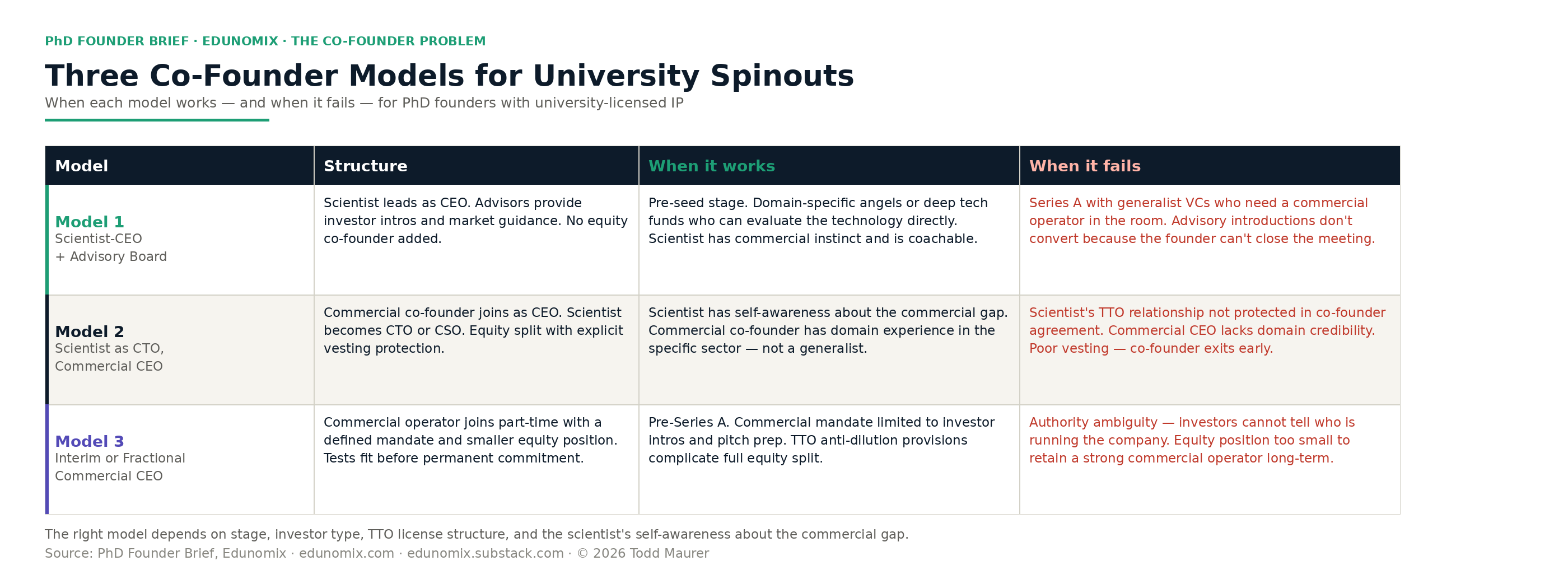
Model 1: The Scientist-CEO with a Commercial Advisor Network
Scientist remains CEO, while a strong advisory board with commercial experience provides investor introductions, market guidance, and presentation coaching. No equity co-founder is added.
When it works: Early stage, pre-seed, when the primary investor conversations are with deep tech angels or domain-specific funds who can evaluate the technology directly. Founder will require sufficient commercial instinct to learn the investor conversation with coaching.
When it fails: When the venture reaches Series A conversations with generalist VCs who need a commercial operator in the room. When the advisory board’s introductions don’t convert because the founder cannot close commercial or investor business.
Model 2: The Scientist as CTO, Commercial Operator as CEO
Commercial co-founder joins as CEO. The scientist/founder transitions to CTO or Chief Science Officer. Equity stakes allocated with vesting protection.
When it works: If the scientist has genuine self-awareness about the commercial gap and is willing to cede operational authority while retaining technical authority. This works best when the commercial co-founder has domain experience in the specific sector, such as a medtech commercial CEO who has run a 510(k) process and sold to hospital networks.
When it fails: When the scientist’s relationship with the TTO, the lab, and the IP conflicts with the co-founder agreement, and if the commercial CEO lacks domain credibility. Also when equioty/vesting protection is flawed.
Model 3: The Interim or Fractional Commercial CEO
In this model a commercial operator joins on a fractional or interim basis, part-time, with a defined mandate and a smaller equity position, while the scientist tests the commercial fit before making a permanent co-founder commitment.
When it works: When the venture is pre-Series A and the commercial mandate is limited to investor introductions and pitch preparation. When the equity implications of a permanent co-founder are complicated by TTO anti-dilution provisions.
When it fails: When the fractional arrangement creates ambiguity about authority. For example, investors meet a fractional CEO and a founding scientist but often can’t tell who is actually running the company. And when the equity position is too small to retain a strong commercial operator through the Series A process.
Strategic Spinouts explicitly offers this model: embedding an interim CEO or business lead for scientist founders who prefer to focus on the technology while ensuring the business side is handled professionally.
The PROVE sequence and the co-founder decision
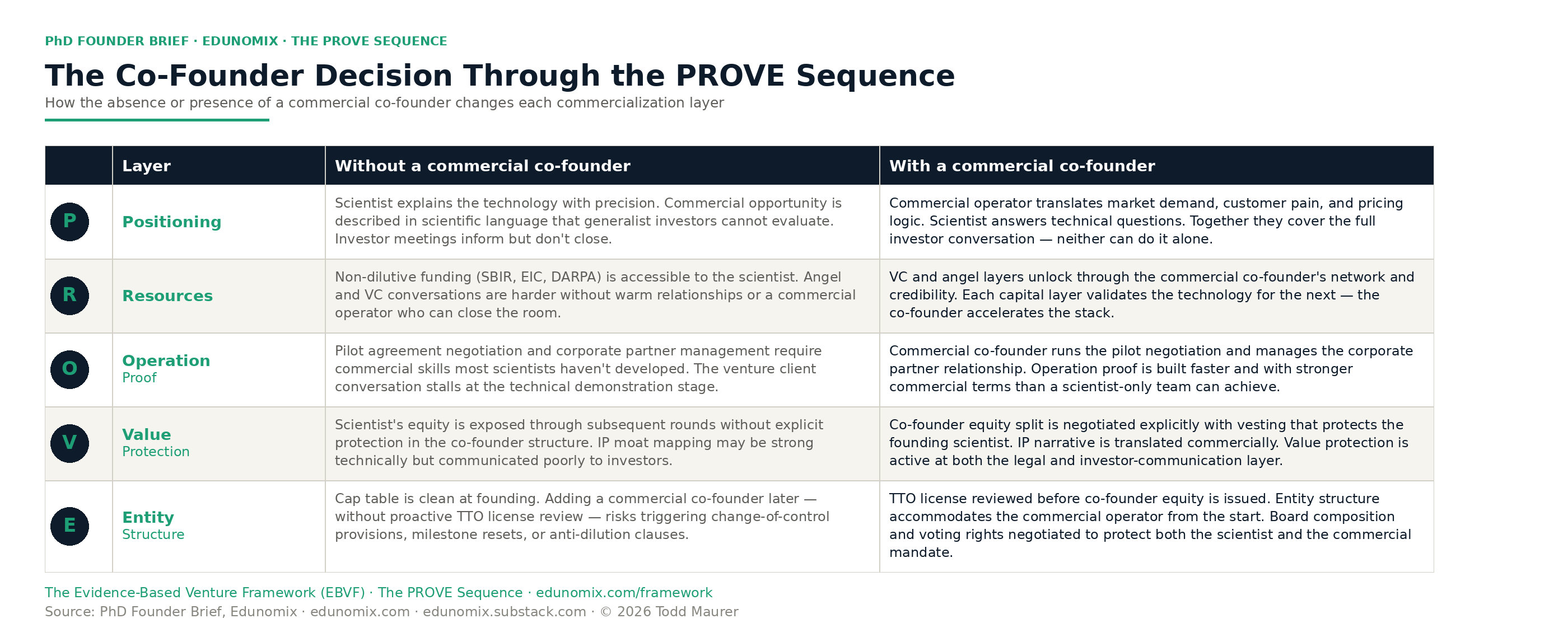
The PROVE sequence, including Positioning, Resources, Operation Proof, Value Protection, and Entity Structure, is the commercialization framework at the center of Edunomix’s advisory practice. For readers new to the Brief, the full framework is at edunomix.com/framework.
Each layer of the PROVE sequence has a co-founder implication, as illustrated below:
ONE ACTION
Before adding a co-founder, or if you’re planning to talk to investors without one, answer these three questions:
1. Is the gap presentation or strategy? If you can’t clearly answer the question “why will a specific customer pay a specific price at a specific stage of market development” perhaps you should consider this a gap. Think also about the experience needed: it may require a person with roughly 10+ years of commercial experience in your sector, not a fresh graduate.
2. What does your TTO license say about new equity issuances? Take a look at the license agreement (if relevant) and read the section on equity. Determine, specifically, whether or not the TTO requires approval for new equity issuances to non-inventor co-founders, and whether adding a co-founder triggers any change-of-control or milestone provisions. If you are at institutions such as Oxford, ETH Zurich, Cambridge, MIT, or any TenU members, there are already specifics policies on this. Do your research.
3. What specific commercial gap are you trying to fill? Finance and sales aren’t often the same person, and investor relationships and customer relationships may also require different skills. Be sure to know precisely which gap you are filling, and only then find someone to hire who has filled that specific gap before, at scale, in your sector.
The scientist who enters investor conversations without a commercial co-founder is not necessarily disadvantaged; she may have engaging personal skills and the ability to execute and build the venture into a commercial success herself. Or maybe not. The scientist who enters investor conversations without having consciously decided whether or not to add a co-founder, and why, is at a structural disadvantage that no pitch coaching can fix.
A note for TTO directors
Choosing a co-founder decision is one of the most consequential choices a spinout founder can make, and TTOs can provide guidance on this with an aim to produce better-prepared founders, cleaner cap tables, and fewer diligence surprises down the line.
The UC Berkeley case is instructive. UC Berkeley’s RISELab produced two billion-dollar spinouts, Databricks and Anyscale, partly because the TTO relationship was not adversarial. Anyscale, valued at $1B in 2021, wouldn’t have existed if the TTO had been adversarial the first time around. The institutional relationship that enabled the second spinout was built during the first.
Questions worth raising at the licensing stage: Has the founding team identified the commercial gap? Is there a plan to address it? And does the license agreement’s equity and milestone structure accommodate a future commercial co-founder without requiring a full renegotiation?
The PhD Founder Brief is published weekly by Todd Maurer — founder of Edunomix, owner of VersatilePhD. Global signals for founders building evidence-based ventures.
Need advice? Work with Edunomix → | TTO or university innovation office? Bring the PROVE sequence to your cohort →
Sources
Global Deep Tech Report: Founder Teams and Co-Founder Data (Munich VC Stammtisch, 2025)
Prof. Dr. Theresa Treffers: LinkedIn presentation of Global Deep Tech Report findings (2025)
Global Venturing: “Entrepreneur vs Academic: Who Makes the Best Leader of a Spinout?” (August 2025)
Deep Tech Leaders: “When Deep Tech Startups Need a Chief Commercial Officer” (April 2025)
IMD: “From Scientist to Founder: Five Tips for Succeeding in Deep Tech” (April 2026)
Voima Ventures: “From Lab to Launch: A Researcher’s Guide to Spinning Out a Deep Tech Startup” (May 2025)
Osage University Partners: “Solving the Equity Equation” (November 2023)
Y Combinator: “How to Spin Your Scientific Research Out of a University and into a Startup”
Fifty Years: “Spinout Playbook” (2025)
Strategic Spinouts: “The University Spinout Playbook” (August 2025)
CASRAI: “Spinout Exits: Acquisition, IPO, and Wind-Down” (July 2026)
Crowley Law: “University Tech Transfer Legal Checklist for Startup Founders” (May 2026)
Zero Carbon Capital: “Spinouts and Success: A VC View on Spinout Equity” · UK Government: “Independent Review of University Spin-out Companies” (November 2023)
Oxford University: Spinout Equity Policy (published) · University of Cambridge: TTO Position on Royalties (Spinout.fyi)
TenU: USIT Guide (2024 Software Edition) ·
Spinout.fyi: Database and Founder Survey Data (2023)
Royal Academy of Engineering and Beauhurst: “Spotlight on Spinouts” (2025)
Deep Science Ventures: Venture Science Doctorate Program (June 2026)
Deep Tech Leaders: “55% of Deep Tech Companies Fail Within Five Years” (2026)
UC Berkeley RISELab: Databricks and Anyscale spinout documentation
Hailey Eustace, Commplicated: Deep Tech Communication Research (2026)