
Your University Signed First. Now Your Investor Wants To. Here's What That Means
Most founders negotiate the valuation. Focus on everything else.


One of the medtech ventures I currently advise is running a SAFE round. The regulatory sequencing is on track, they have a manufacturing LOI in place, and NIH and NSF applications are in review. By most measures, raising a Series A round is still a long way off.
Yet, given the company’s commercialization plans, we’ve already shifted the conversation to what comes after FDA clearance, which could include a strategic partnership with a larger medtech company or a corporate venture arm that has already expressed interest. The Series A, if and when it arrives, may not be a traditional VC round at all, but rather a strategic investment from a partner with distribution infrastructure and a reason to own the technology segment.
No matter the future path, the next serious investor conversation beyond start-up capital will require deeper term sheet literacy. This is because a corporate strategic investor’s term sheet looks nothing like a traditional VC term sheet: liquidation preferences, board dynamics, IP provisions, and drag-along rights all have different implications when an investor also happens to be a potential acquirer or distribution partner. Moreover, adding in university tech transfer conditions further complicates the picture.
What do founders who are further along de-risking sequence need to understand about term sheet structure? I’ll highlight a few areas in this note. But making early mistakes is increasingly costly. The Series A market is now more selective than at any point since 2021, with approximately 2,800 rounds closed in the US in 2025, down from 4,200 in 2021. Investor terms will reflect that selectivity.
The SAFE round a founder may have completed is intentionally simple because it defers the hard structural questions to the priced round (Series A or acquisition). But that also means that the subsequent term sheet takes on all the weight that the SAFE deliberately avoided, so that getting it right is critical, particularly for university-backed ventures.
Why the standard term sheet guide fails PhD founders
Generic term sheets, such as for software businesses, include standard VC provisions. But for a PhD founder with university-licensed IP, a term sheet has an additional layer that is less often addressed: interaction between the investor term sheet and the existing TTO license agreement.
A typical VC term sheet covers valuation, board voting rights, and exit clauses, while a spinout term sheet brings a more complex document environment that includes the TTO license agreement, faculty inventor equity commitments, royalty obligations, and university equity stakes that were established before any commercial investor discussions.
What are the practical implications? A PhD founder signing a Series A term sheet should have their TTO license agreement and their investor term sheet reviewed together, since provisions in one document can conflict with provisions in the other. And while this seems straightforward, don’t assume that the VC's counsel or the TTO's counsel will flag it; they often don’t.
Worst case scenarios for not paying attention? Stacked liquidation preferences that leaves founders with nothing; a full ratchet anti-dilution that wipes out equity; or an option pool shuffle that transferred millions in value without a trace (an option pool shuffle is when investors require a large employee stock option pool to be created before their investment, which dilutes founders before an investment arrives). University spinouts also surface issues, and they are often less known because cases don't go on the record, often to protect ongoing university relationships. For example, a PhD founder who negotiated a drag-along clause which excluded the university shareholder and, in turn, prevented a key strategic deal from closing. And there are others.
Summarized in the table below is a comparison of TTO/University term sheets with with generic counterparts, illustrating some of these differences.
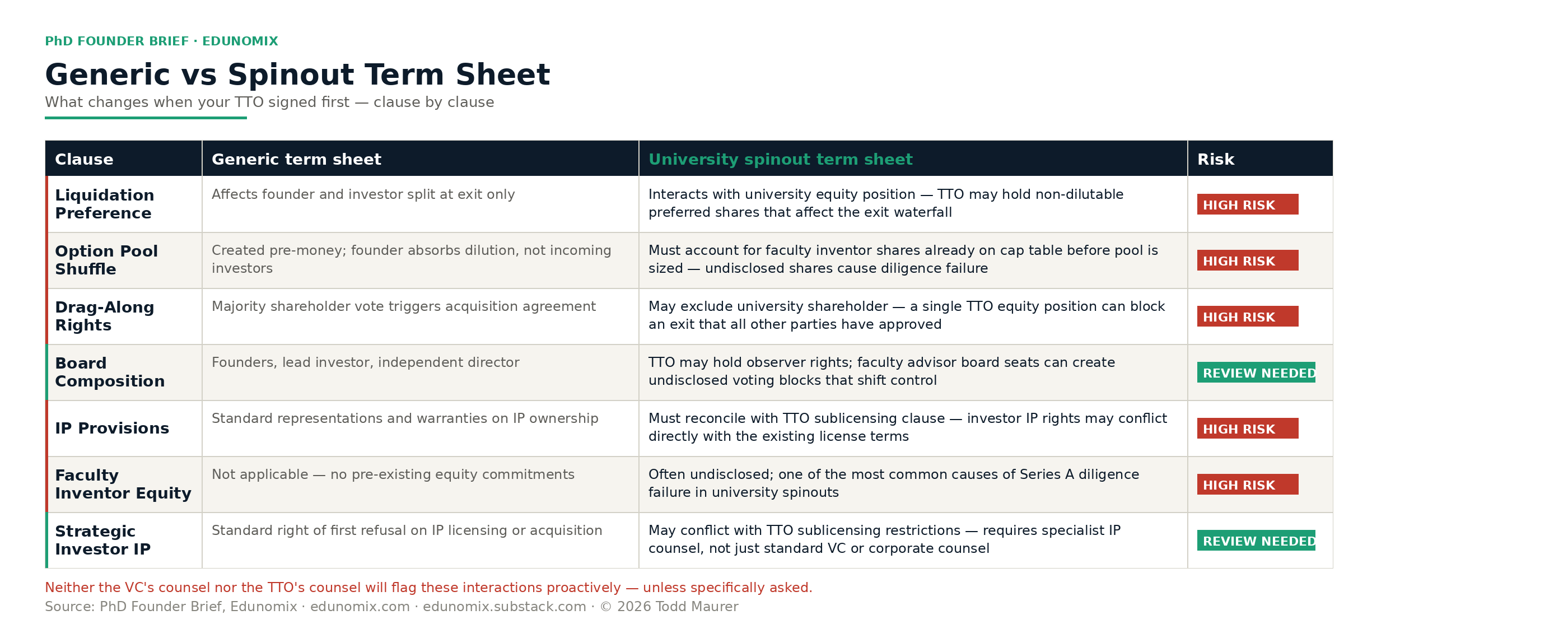
Four specific TTO-term sheet issues should be considered by every PhD founder seeking to spin-out and raise capital, and are explained below.
University equity and the exit waterfall. If your spinout includes university ownership, check the “percentage of proceeds from any liquidity event” clause in the TTO agreement. This is essentially non-dilutable equity so it affects the exit waterfall (which is the order in which proceeds from a sale or liquidity event are distributed: investors with liquidation preferences get paid first, then preferred shareholders, then common stockholders including founders) even though it may not show up in the capitalization table. Don’t assume venture investors have modeled this when they proposed their liquidation preference structure. If the university holds non-dilutable equity, a buyer has to negotiate with the TTO as a separate party, which can slow or even thwart an acquisition, even when other shareholders have approved it.
Royalty obligations and valuation. TTO agreements generally include ongoing royalty payments. These obligations reduce the effective revenue available to investors and will impact both valuation and exit calculations. Be certain that your investors have modeled any royalty arrangements before a term sheet is signed. A royalty obligation that reduces net revenue by, say, 3–5% annually, impacts profitability, valuation multiples, and exit math.
Sub-licensing and the Series A. The typical sub-licensing clause in a TTO license grants permission to sublicense a technology to a third party. If the Series A term sheet includes provisions that could trigger a sub-license, for example, through a partnership, a corporate pilot, or an acquisition structure, these need to align with the TTO agreement. This is particularly relevant for a medtech venture because medtech strategic investors frequently seek distribution rights or co-commercialization arrangements as part of their investment thesis, and these arrangements may constitute a sublicense under the TTO agreement.
Faculty inventor equity. Faculty and student inventors often hold equity or advisory shares in deep tech ventures at the start-up stage. These need to be fully disclosed in the cap table before Series A closes. While this may seem self-evident, undisclosed equity commitments are actually a serious problem that investors commonly find during due diligence and university spinouts are a good source of this. Over 35% of early-stage biotech startups cite cap table conflicts and broken equity structures as one of the top three reasons for failing to close a Series A round (Source: Crowley Law, April 2026).
Beyond the TTO-specific interactions above, there are at least seven clauses in any term sheet, VC or strategic, can determine whether a founder exits well.
Clauses that determine exit success
1: Liquidation preference
A liquidation preference is a contractual right that gives investors priority over founders and common stockholders when a company is sold or liquidated. According to iLearnLot's 2026 term sheet analysis, the market standard today is 1x non-participating preferred. This means that investors get their money back first, while the rest goes pro-rata to all shareholders. As a rule of thumb, anything above 1x (or any participating structure) means that during an exit investors get paid preferentially before founders see anything significant.
What are the implications for a deep tech founder with a longer (say, ten-year) commercialization timeline? A participating liquidation preference can be particularly dangerous because deep tech exits often happen at modest multiples. Consider a $40M acquisition of a company that raised $12M at Series A. Under 1x non-participating: investors receive $12M, founders split the remaining $28M. Under 2x participating: investors receive $24M first, then participate pro-rata in the remaining $16M, leaving founders with significantly less than half of what they would have received under standard terms.
According to Cooley LLP's Q2 2025 Venture Financing Report, 60% of Series A term sheets included a participating liquidation preference, up from 40% in 2023, so it’s an important clause to get straight and negotiate hardest. An issue like a liquidation preferences may not feel urgent, but it can be consequential when eventually negotiating an exit. Pay attention to it.
2: The option pool shuffle
Option pools for employee equity is often created at the earliest start-up stage, pre-money, which means founders bear all the dilution from the pool rather than investors. Pre-money means the company's valuation before funding happens, so a 15% pool created at a $40M pre-money valuation costs founders 15% of that $40M before investors pay a dollar. According to data from Carta, over 95% of term sheets specify the pool comes from pre-money.
Moreover, option pools have expanded from 15% averages to 18–20% in 2025–2026. A $12M raise at a $40M pre-money sets the post-money at $52M, where new investors receive roughly 23%, and after the option pool expansion founders are pegged at roughly 36–37%. If a founder concedes five extra percentage points unnecessarily on the option pool and the company reaches a $200M exit, those five points represent $10M in lost value. My suggestion is the negotiate the pool size down to what you will actually need in the next 12–18 months in terms of hiring. Push for the pool to come out of post-money if possible.
3: Anti-dilution
Anti-dilution provisions are designed to protect investors if a future round happens at a lower valuation than the one they entered at. Typically this is a broad-based weighted average. Founders should avoid what is called a “full ratchet” at all costs.
Full ratchet means if your next round prices lower, the Series A investor’s conversion price adjusts all the way down to the new price which can potentially wipe out founder equity in a down round scenario. For a deep tech venture with a ten-year commercialization timeline, a down round is a serious risk. According to Fenwick and Aumni's Venture Beacon 2024, 46% of deals include strong anti-dilution protections, so treat this as a key negotiation item.
4: Board composition
Who sits on your board will determine your job security, acquisition decisions, and freedom to make strategic choices. A typical Series A board includes 2 founders, 1 lead investor, and 2 independents. Certain VCs will push for a 3–2 investor-majority board at Series A, which essentially is a company that a founder no longer controls.
The specific risk for PhD founders is this: the independent director seat is often the pivot that changes control. For example, an investor who directly nominates the “independent” director will most likely have effective control of the board. In one documented case, a biotech founder lost board control during crucial FDA trials because voting shares had been granted prematurely to a key scientist who left before Phase II trials began. Founders should negotiate for a mutually agreed independent director selection process rather than allow any unilateral investor moves, and aim to maintain founder majority or parity through at least Series B.
5: Pro-rata rights
Standard pro-rata rights are reasonable because they allow investors to maintain their percentage in future rounds and signal long-term commitment. There is no need to push back on standard pro-rata demands.
However, what are called “super pro-rata rights” are a different matter. These give investors the right to purchase more than their proportional share in follow-on rounds (up to 50–100% of the new round). The problem with this is that it can crowd out new investors; but more seriously, it can allow existing investors to acquire the company at distressed valuations while blocking outside capital that might offer better terms. This often happens precisely when the founder most needs new perspectives and new capital. Super pro-rata rights should be firmly resisted.
6: Drag-along rights
Drag-along provisions allow a majority of shareholders to force minority shareholders to agree to an acquisition. This is standard and generally acceptable, but when and how it is triggered matters for spinout founders.
Check whether the university (via the TTO agreement) is included in or excluded from the drag-along calculation. A university shareholder who can’t be dragged can block an acquisition. It’s not uncommon to see an acquisition killed by a minor investor wielding disproportionate power through drag-along mechanics. For spinout founders, the university shareholder can replicate exactly this dynamic at the exit moment, with no remedy available if the drag-along was not structured correctly at Series A.
7: Protective provisions
Investors often have two powerful vetoes: a veto on a financing and the veto on a sale of the company. Many term sheets use technical jargon that obscures the fact that a single investor, no matter how small, can block the company from raising new capital or agreeing to an acquisition.
Non-standard provisions to look out for include veto rights over new equity issuances, veto rights over acquisitions below a specified price, and veto rights over changes to the certificate of incorporation. Each of these can provide a minority investor with effective control over the company’s future plans. When down rounds increase, more investor-protective structures will follow.
A term sheet ultimately reflects the investor’s values. Read it accordingly.
When the investor is a strategic: a medtech case
For a medtech venture approaching FDA clearance, the most likely next financing will not be a traditional VC round. It may be a strategic investment from a larger medtech company that has distribution infrastructure and wants to position itself in the market.
A strategic investor’s term sheet has different implications across several clauses that are not covered above, including:
Board composition. A strategic investor with a board seat is not necessarily neutral and has ongoing visibility into the company’s commercial strategy, partnership pipeline, and competitive positioning. Board information rights need to be negotiated carefully to include what information the strategic board member has access to, and under what circumstances they can be required to recuse themselves from commercially sensitive discussions. This raises a materially different concern than the board composition question in Clause 4.
IP provisions. Strategic investors sometimes have right of first negotiation or right of first refusal clauses related to IP licensing or acquisitions. These can limit the company’s ability to pursue other strategic relationships. Even worse, for a medtech spinout with a TTO sub-licensing clause already in place, a strategic investor’s IP rights can create a three-way conflict between the TTO agreement, the investor term sheet, and future partnership options.
Drag-along and co-sale rights. The drag-along conflict of interest noted in Clause 6 above is amplified when the investor is also a potential acquirer. That needs to be explicitly addressed in the term sheet.
As the foregoing shows, the strategic investor term sheet is not inherently unfavorable to a founder, and can have real advantages in terms of commercial scale. A well-structured strategic fundraise can also be exactly the right next step for a medtech venture post-FDA clearance. However, it requires a different analytical framework than a standard VC term sheet and more specialized legal advice.
ONE ACTION
Before signing your next term sheet, or before your next investor meeting, do three things:
1. Model three exit scenarios. Apply three liquidation preference structures to your expected raise: 1x non-participating, 1x participating, and 2x participating. Then calculate founder proceeds at a 1x, 3x exit, and 10x exit under each structure. These scenarios will give you an idea of the range for negotiation, and what you may be willing to accept. If you can‘t build that model, that’s an information gap you need to fill now.
2. Review your TTO license agreement based on the four clauses. Sub-licensing rights. Royalty obligations. University equity and anti-dilution provisions. Faculty inventor equity commitments. These need to be reconciled against any investor term sheet. Have your attorney reconcile the four clauses against the investor term sheet before you sign anything. Neither the VC’s counsel nor the TTO’s counsel will do this proactively.
3. Negotiate board composition before valuation. Most PhD founders spend their negotiating energy on valuation, but board composition can have an outsized impact on operations. Focus on maintaining a founder majority or parity through at least Series B, and choose board members jointly.
Founders who close the most successful Series A rounds are not the ones who accepted the first term sheet. They are the ones who understood every clause before they negotiated any of them.
A note for TTO directors
If any of your spinout founders are approaching their first institutional round, or strategic investor discussion, this issue is worth sharing directly. The interaction between the investor term sheet and the existing TTO license agreement is the most consistently overlooked structural risk in early-stage spinout financing.
From a sample of 205 spinout founders, the Net Promoter Score for the spinout process is -52 worse than large banks (Spinout.fyi, 2023). The term sheet is one of the moments that score is earned. A founder who understands both documents before signing has a better chance of succeeding, while also preserving a productive post-closing relationship with the University TTO .
The PhD Founder Brief is published weekly by Todd Maurer — founder of Edunomix, owner of VersatilePhD. Global signals for founders building evidence-based ventures.
Need advice? Work with Edunomix → | TTO or university innovation office? Bring the PROVE sequence to your cohort →
Sources
Angel Investors Network: “Series A Funding Requirements 2026: What Investors Expect” (May 2026)
Angel Investors Network: “Series A Funding Requirements 2026: What Changed” (July 2026) ·
CurrentCFO: “Series A Term Sheet Decoded” (June 2026) · VC Beast: “Series A Funding Guide 2026” (April 2026)
VC Beast: “The Anatomy of a Venture Capital Term Sheet in 2026” (March 2026) ·
iLearnLot: “Term Sheet Negotiation for Founders in 2026” (May 2026)
Angel Investors Network: “Term Sheet Negotiation Playbook for Founders” (April 2026)
Value Add VC: “What Is a Term Sheet? Every Clause Explained for Founders” (May 2026)
Startup Project: “Term Sheet Template: Key Clauses, Examples, and What Founders Must Negotiate” (May 2026)
Fiscal Lion: “Term Sheet for Startups: A CFO-Level Guide” (June 2026)
Going VC: “Term Sheet Provisions VCs Must Pay Attention To” (2025) · Qubit Capital: “Term Sheets for Founders” (2025)
Sifted: “Spinout Term Sheets: Explained” (December 2023)
Columbia Technology Ventures: “Term Sheet Recommendations for Launching University Life Science Startups” (Spring 2020)
Fifty Years: “Spinout Playbook” (2025)
Zero Carbon Capital: “Spinouts and Success: A VC View on Spinout Equity” (2024)
Spinout.fyi: Founder Survey Data (2023)
Crowley Law: “Equity Strategy for Cap Table, Dilution and Founder Control” (April 2026)
Allied VC: “Founders Guide: Liquidation Preferences” (2025)
Cooley LLP: “Q2 2025 Venture Financing Report”
Fenwick and Aumni: “Venture Beacon 2024”
CRV: “Equity Dilution Explained: A Founder’s Guide” (April 2026)
Photo by Mufid Majnun on Unsplash