
The World's Top Deep Tech Spinout University isn't in America
What ETH Zurich's global lead tells PhD founders about where to build, and where capital is moving

Over the course of advising deep tech ventures in Europe, I see one pattern repeating itself. The institutional ecosystems producing these companies are extraordinary: multiple ventures at different stages, each tackling a distinct problem, each with access to commercialization infrastructure that most US founders would envy. And increasingly, exiting at valuations that rival many deals coming out of the US.
The assumption that you need to be in Silicon Valley, Boston, or at minimum have a US entity as your primary home, is quietly being dismantled. The university spinout data, particularly from Switzerland, makes that case better than any argument I could construct.
European Spinouts led by ETH Zurich

Photo by Thimo Pedersen on Unsplash
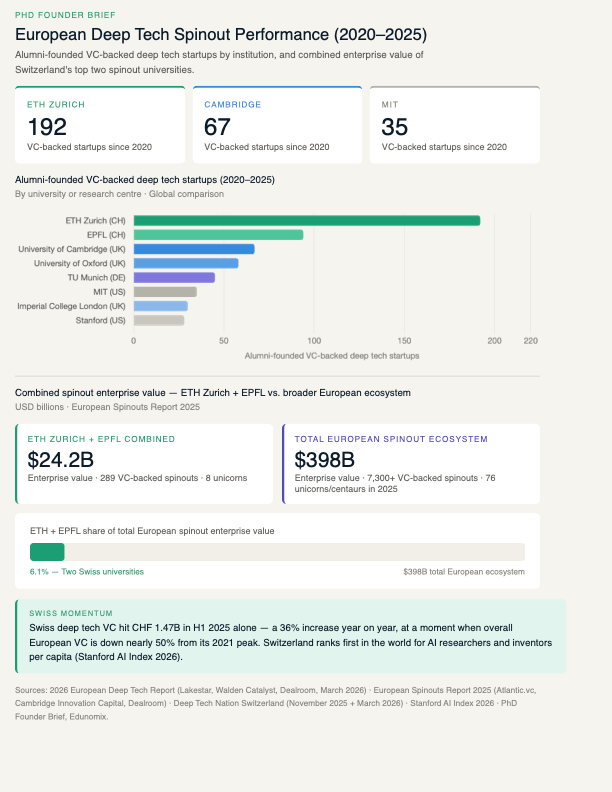
Consider first that ETH Zurich has produced 192 alumni-founded, VC-backed deep tech startups since 2020, which is more than any other university or research centre in the world. Cambridge produced 67 over the same period. MIT produced 35.
The 2026 European Deep Tech Report attributes ETH’s output to Switzerland’s high R&D spending as a percentage of GDP, world-class research infrastructure, and the ability to attract top international scientific talent. But the data points to something more specific: the institutional model itself.
As with some of the best US university tech transfer offices, ETH Zurich has streamlined commercialization through what it calls “express licensing,” allowing for negotiation-free agreements completed in six to eight weeks for just 2% equity. The typical spinout process involves proof-of-concept, IP protection, company formation with university equity stakes of 5–25%, seed funding, and commercialization.
This is a sequence that can take years and extract significant ownership before a founder has raised a dollar. But here, ETH’s model compresses the most painful part of that process: its dedicated commercialization office, ETH Transfer, supports founders across the full pathway from lab to market entry, with external partners embedded at each stage.
The results are measurable.
ETH Zurich and EPFL, both Swiss institutions, together hold the first and third positions in European spinout value creation, with a combined 289 VC-backed spinouts, 8 unicorns, and $24.2 billion in enterprise value. Within Europe, Switzerland and the Nordics now have the most progressive and founder-friendly technology transfer models in Continental Europe, which explains why Swiss universities convert research into startups at such disproportionate rates.
The numbers behind that claim are worth seeing in full:
Moreover, the ventures coming out of this system are not academic exercises. ANYbotics is an ETH spinout building autonomous industrial inspection robots, and has raised over $150 million and is cited by Walden Catalyst as an example of European deep tech scaling into global industrial markets. Climeworks, also from ETH, is the global leader in direct air carbon capture. Neural Concept, an EPFL spinout focused on AI-driven engineering, has raised $100 million. These businesses are now operating at global scale.
EUROPE’S RELEVANCE TO EARLY STAGE VENTURES: ANOTHER OPTION?
Early stage founders need optionality. The last thing they need is get stuck in a predetermined funding loop rather than actually building and solving problems. Europe provides early optionality, with university spin-outs drawing capital from both an increasingly active local investor base as well as US-based investors. Nearly 50% of late-stage funding for European deep tech and life sciences spinouts comes from outside Europe, mainly from the US (over 90% of European deep tech specialist investors have fund sizes below €300M, meaning they largely cannot lead Series B+ rounds).
As a result, Europe is one of the world’s most productive spinout engine at the early stage. For PhD founders, the opportunity is real, but you need a strategy based on where the growth capital comes from at each stage. And you need to know where to go.
The Clustering Effect
According to the 2026 European Deep Tech Report, Europe has two leading super-clusters. One, the “New Palo Alto” includes London, Cambridge, Oxford, Paris, Amsterdam, and Berlin, which account for roughly 30% of European VC-backed deep tech startups. Two, the “Alpine Tech Cluster” of Zurich, Lausanne, Grenoble, Munich, Milan, and Vienna, accounting for 13% deep tech startups and hosting 1,100+ startups overall. 
There are also broad non-dilutive funding options at the EU level, such as EIC which has backed 1,100+ spinouts with $4.2 billion in grants since 2020.  The surge in billion-dollar spinouts validates that Europe can compete globally in frontier technologies, and therefore supported by pan-European funding as well.
ONE ACTION
Before assuming you need to stay in the US to build, map two things this week: your institution’s commercialization infrastructure, and your eligibility for European programs.
If you’re at a European institution: The highest-performing tech transfer offices such as ETH Zurich, EPFL, Oxford, Cambridge, TU Munich, and Max Planck, each have dedicated commercialization support, express licensing models, and pre-seed funding specifically for PhD founders. ETH’s express licensing model offers negotiation-free agreements completed in six to eight weeks for just 2% equity, a better deal than most seed investors offer. If you’re not at one of the top five, identify the nearest national equivalent such as Innovate UK, Bpifrance, EXIST in Germany, before approaching any external investor.
If you’re a US-based PhD founder: The door to Europe is not closed, but it has specific entry conditions worth understanding before you plan around it:
The EIC Accelerator requires applicants to be established in EU Member States or Horizon Europe associated countries. However, companies headquartered outside the EU but with a subsidiary in an eligible country may apply through that subsidiary. That means a US-based founder with a European research partner, a European co-founder, or a willingness to establish a European entity has a viable path to €2.5M in non-dilutive grants plus up to €10M in equity.
One critical 2026 update: applicants controlled by non-EU or non-associated holding companies, including standard “Delaware flips,” are no longer eligible for EIC funding. This is a meaningful change that has caught many US-founded European subsidiaries off guard. If you’re structuring a dual entity, get legal advice on the ownership structure before assuming EIC eligibility.
The opportunities for US founders in Europe are real but they require structural planning, not just a grant application:
—> Establish a European entity in an eligible country, with genuine operational presence. Switzerland, the UK, and the Netherlands are the most founder-friendly entry points for US deep tech founders.
—> Partner with a European institution. EIC Pathfinder and Transition programs support consortia of 2–5 partners. A US-based researcher partnering with ETH, EPFL, or a Max Planck institute can access EIC funding through the consortium structure without requiring a European company.
—> Target university spinout funds directly. Cambridge Innovation Capital, Oxford Science Enterprises, Atlantic.vc, and PSV Hafnium all back spinouts from their associated institutions — and those institutions actively recruit international PhD talent. Being affiliated with the right European institution is itself a non-dilutive funding strategy.
—> Use SLINGSHOT as a zero-barrier entry point. Singapore’s global deep tech pitching competition is open to startups registered anywhere in the world within the past ten years; no European entity required. Grand prize S$400K. It can serve as an early test of whether your venture translates internationally before committing to a European structure.
The bottom line for US PhD founders: Europe is not a consolation prize and it is not closed to you. Yet accessing it requires clear structural decisions such as entity formation, partnership design, and ownership structure. Make them early, before the grant deadline is two weeks away.
Sources
2026 European Deep Tech Report (Lakestar, Walden Catalyst, Dealroom, March 2026)
Deep Tech Nation Switzerland (March 2026 + November 2025)
European Spinouts Report 2025 (Atlantic.vc, Cambridge Innovation Capital, Dealroom)
TechCrunch (December 30, 2025)
ETH Zurich Department pages (Q4 2025)