
The Evidence-Based Venture Framework
A commercialization sequence built specifically for research-backed ventures, and the five layers most founders are missing.


In an era of hype and marketing, would an evidence-based startup guide be helpful to PhD founders?
I thought yes. That's why I started this newsletter, and why I've been deliberate about what goes into it. Every issue of the PhD Founder Brief has been about a specific topic: a geography, a funding mechanism, a negotiation, a regulatory pathway. And these topics were chosen because they build toward a single integrated framework for how research-backed ventures earn investor conviction and, ultimately, funding.
I’ve named this the Evidence-Based Venture Framework.
“Evidence-based” is the term that runs through everything Edunomix does, and everything VersatilePhD has built over a decade. This includes evidence-based career strategy. Evidence-based assessment. Evidence-based commercialization. The framework is an explicit articulation of what “evidence-based” means in practice for a founders navigating the gap between lab and funded venture.
Why do I think it’s helpful? Because generic investor readiness frameworks often fail PhD and deep tech founders. To understand this, let’s look at how start-ups are structured differently.
University spin-outs and research ventures are different
Research-driven ventures pose unique challenges, starting with funding. In 2025, only 18% (Pitchwise, 2026) of seed-funded companies went on to raise a Series A round, which is a historic low rate. The average time between seed and Series A, a measure of progression, has also stretched to around 616 days. In general, seed investors bet on a broad vision; Series A investors demand specific, validated proof of concept. That creates a gap.
For many startups, such as software, well-known metrics such as ARR (Annual Recurring Revenue), CAC (Customer Acquisition Cost), and conversion rates (the percentage of prospects who become paying customers) can help investors assess this “gap” and better assess risk, growth, and investment returns. But for many PhD founders building deep tech spinouts, those metrics don’t exist (or won’t for several years). Return on investment timelines in deep tech run 8–12 years versus 4–6 years in consumer tech and fintech, so it’s not surprising that they suffer higher mortality and failure-to-commercialize risks. Deep tech is also expensive to develop: a synthetic biology company might burn $20 million before generating any revenue. A quantum engineering venture might have three years of development before it commercially deploys anything. I’ve seen traditional due diligence frameworks frequently fail when confronted with bleeding-edge physics or molecular biology, largely because a technical risk assessment requires domain expertise that many generalist investors simply don’t have (and, again, with no readily available metrics to use).
University TTO data clarifies this trend further. The commercialization gap between research and funded venture is real, and widening. As federal research funding cuts begin to reduce the pipeline of invention disclosures at US universities, according to AUTM CEO Stephen Susalka, TTOs are under more pressure than ever to move technology to market. The founders who understand the full commercialization sequence are the ones who will close that gap.
What might they need to understand? Research cited by Qubit Capital shows that startups with patents are 35 times more likely to succeed, yet the commercialization rate from research to funded venture remains low. Progression is also uneven. At the more developed end of the market, the University of California system creates more than 80 spinouts per year; most other universities produce far fewer in number. The University of Minnesota, one of the more active TTO operations in the US, has achieved a long-term spinout success rate of 69% across 286 companies since 2006, a figure that implies a 31% failure rate even at one of the better-resourced institutions. TTOs operating with significantly fewer resources often produce much lower success rates.
Bottom line? Survival rates, funds raised, and successful exits are all higher among university and alumni-based startups built on university-licensed technology, which means that IP foundation matters. Yet, IP alone is not enough. The commercialization sequence that sits between the TTO agreement and funded venture is where most spinouts stall.
The scale of the opportunity makes this challenge more urgent for today’s founders. According to StartUs Insights, deep tech now accounts for roughly 20% of global venture capital. In Europe, deep tech attracts a massive 44% of all technology investment. In 2026 through April, deep tech companies raised $223 billion in equity funding, a 232% increase over the same period in 2025. There is no doubt that capital is available; the question is, are PhD founders positioned well to access it?
In my experience, most are not. Founders who view fundraising as a readiness challenge consistently get investor attention and better funding terms. Founders who treat fundraising as storytelling without metrics can struggle to secure serious engagement, or any at all. Moreover, the definition of readiness for a research-backed venture is fundamentally different from what exists with generic startup frameworks. The traction, financial discipline, and scalability that many investors expect look very different when the venture is built on university IP, navigating TTO relationships, grant agencies, and regulatory clearance.
Our Evidence-Based Venture Framework is built to help such research ventures. The difference is about deliberately sequencing a commercialization roadmap where the de-risking instruments are grants, pilots, IP layers, and regulatory pathways rather than ARR, conversion rates, or other common measures for start-ups. The challenges are different for many deep tech founders; that requires an alternative approach.
Why now?
Institutions in the US and around the world recognize that PhD founders need a different commercialization framework. Moreover, it’s imperative that institutions themselves create more value and cohort opportunities from their vast and often government-funded research pipelines.
A few examples:
Carnegie Mellon University launched a Deep Tech Venture-Ready Program in April 2026, catalyzed by active deep tech VCs such as Accel, Khosla Ventures, Lightspeed, and DCVC. The program focuses on helping founders understand how investors evaluate technical risk, capital efficiency, platform defensibility, and fund economics.
A peer-reviewed article in Science called explicitly for supporting PhDs building deep tech ventures, citing lab-to-market programs at Harvard, The Engine, and Breakthrough Energy as institutional responses to the gap.
Deep Science Ventures' “Venture Science Doctorate,” the world's first PhD program built around venture creation rather than traditional research, is designed to create high-impact, de-risked companies that can launch with a clear path to commercialization.
These innovative initiatives address an underlying problem: the commercialization training that PhD founders need does not usually exist inside academia, and most of what exists outside of it was built for software and tech-light startups, not research-backed ventures.
Our framework attempts to closing this gap by integrating sourced intelligence from this newsletter, real-world advisory engagements, and two decades of working with PhD researchers and spin-outs. Our goal is to iterate and apply this Framework, based on the PROVE sequence below, to the numerous PhD researchers who can benefit from it.
Five layers: the PROVE sequence
The Evidence-Based Venture Framework organizes the commercialization journey into five sequential layers; what we call the PROVE sequence. Each layer proves something to the investors and stakeholders in the sequence. Each lessens overall risk. Founders who succeed are not necessarily those with the best technology, but rather who have proved the right things, in the right order, before engaging with investors.
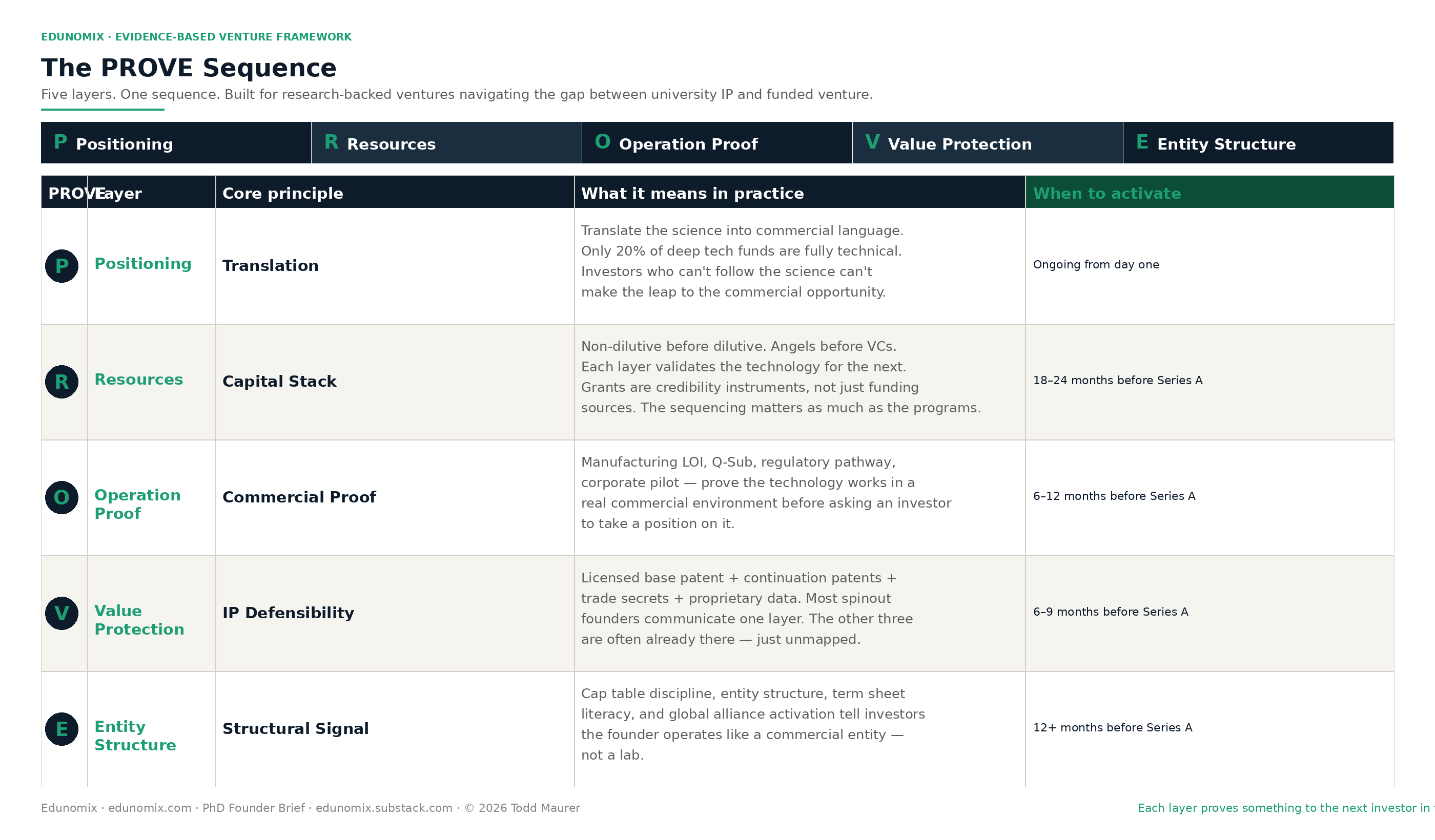
P: Positioning
From (previous reference post): Lost in Translation
Before any commercial de-risking happens, founder need to translate the science into commercial language. Not dumb it down; translate it. Investors who can’t follow the science can’t make the leap to the commercial opportunity, while investors who can follow the science are rare and heavily sought after, and often less available.
Positioning is not a one-and-done deal. It compounds across every subsequent layer, from the capital stack conversation, the pilot agreement, the IP diligence, and the term sheet negotiation. Every layer requires the founder to communicate the same commercial defensibility, but to a different audience.
I encountered this most directly with a deep tech energy venture in Europe whose founding team could describe their technology with extraordinary precision, but were silent when I asked them to explain in plain language what their IP blocked commercially.
R: Resources
From: The Non-Dilutive Playbook and The Deep Tech Angel
Non-dilutive before dilutive funding. Angels before VCs. Government grants before corporate investment. In this sequence, each layer validates the technology for the next layer’s investor type, and advantages the founder for the next conversation.
As noted in previous posts, the $6.3B"+ annual SBIR/STTR pool, the €1.4B EIC, and the $5B+ MENA sovereign programs are not just funding sources. They build credibility. A founder who engages an angel investor with an NSF grant is asking the angel to validate a commercially interesting technology (which they cannot validate themselves). A founder who arrives without this may face a much harder ask.
Sequencing also matters. Most PhD founders I work with approach the layers in the wrong order, or they skip layers entirely, going straight to VC before the non-dilutive and angel layers have done their de-risking work. That is often a mistake.
O: Operation Proof
From: The Venture Client Model and The Regulatory Roadmap
The pilot precedes the investment. The regulatory pathway precedes the round. Both are the same argument from different angles: prove the technology works in a real commercial environment before asking an investor to take a position on it.
For deep tech founders, the relevant traction is not ARR but a manufacturing LOI that proves the technology is manufacturable at scale; or a Q-Sub meeting that proves the regulatory pathway is mapped; or an EIC Transition grant that proves the commercialization sequence is credible; or a corporate pilot with companies such as Aramco or Siemens that proves industrial demand.
I’m currently working with two ventures at different stages of this layer. A medtech venture structured a manufacturing LOI and initiated regulatory sequencing before opening the SAFE round. A Swiss energy venture is mapping its EU regulatory touch points before the IP reaches commercial deployment. Both are building operating proof before the equity conversation, not in parallel with it.
V: Value Protection
From: The Spinout Negotiation and Your Patent Is Not Your Moat
The TTO negotiation will determine what you own, while the four-layer IP moat framework determines how you communicate what you own. Together they answer the investor’s central defensibility question: why can’t a well-funded competitor replicate this?
For spinout founders, this layer is more complex than any generic checklist: the university may own the base patent, while the founder has built the IP moat on top of it, but this is often unmapped and not communicated. I worked with a materials science founder who assumed her IP was entirely the licensed base patent her TTO filed. When we mapped all four layers (licensed base patent, continuation patents, trade secrets, and proprietary data) she discovered three distinct manufacturing protocols not in the patent, eighteen months of pilot data, and two unfilled continuation claims. None of it had been communicated to investors despite having already raised seed capital. That gap was costly, and also entirely preventable.
E: Entity Structure
From: The 63-Year Clause and MENA, Israel and Your University's Deep Tech Door
Cap table discipline, entity structure, term sheet literacy, and global networks show investors that the founder operates like a commercial entity rather than a lab or academic department. This is the layer most PhD founders underestimate because it feels more administrative than strategic. They are bored with it or don’t want to learn.
The so-called 63-Year Clause (in a previous post) showed what happens when founders approach corporate partners without structural preparation: in this case, a royalty clause that ran for 63 years at realistic deployment volumes, with no leverage to push back. The MENA and Israel issue showed another angle: that is, international research alliances that universities build with governments and sovereign funds are commercial assets that most PhD founders have never activated.
Ultimately, founders benefit from structure before capital. When they can clearly articulate how investment will be deployed against explicit milestones, they establish trust. If they cannot, investors will hesitate.
The full framework, including the PROVE audit questions and workshop program, can be found at edunomix.com/framework.
The framework in practice: three client cases
Three advisory cases across the Brief's past issues show the framework in practice:
The Swiss deep tech energy venture touches R, O, V, and E: the deep tech angel discussion, the 63-Year Clause, the venture client model, the IP translation gap, and the regulatory roadmap. It has world-class scientific team with solid IP and a dual commercial model, but its primary challenge is the commercial infrastructure surrounding the science. The Framework is precisely what this team needed from day one: a sequenced roadmap rather than a series of disconnected tactical decisions.
The medtech venture illustrates O most clearly: Operation Proof in action establishing a manufacturing LOI before the SAFE/investment round, have NIH and NSF under review, and a regulatory pathway mapped before initial investor discussions. This is the framework in its most direct form: de-risking happening in the right order, before capital discussions.
The materials science founder illustrates V, Value Protection, by discovering more IP than she realized when the four-layer moat was mapped for the first time. In this case, the IP defensibility layer finds commercial assets that exist but haven’t been articulated. It is often the fastest layer to strengthen because the underlying assets are usually already there.
ONE ACTION
This week, audit your venture against the PROVE sequence.
P (Positioning): Can you explain your technology’s commercial defensibility in plain language (not scientific language) in under two minutes? If not, start there. Everything else in the sequence depends on it.
R (Resources): Have you exhausted the non-dilutive layer before approaching angels? Have you approached angels before VCs? Is each layer building credibility for the next, or are you skipping ahead and asking investors to do work the previous layer should have done?
O (Operation Proof): Do you have a signed pilot LOI, a regulatory consultation booked, or a grant stage completed that validates the technology in a real commercial environment? Has the technology been proven outside the lab?
V (Value Protection): Have you mapped all four layers of your IP moat: licensed base patent, continuation patents, trade secrets, and proprietary data? Can you answer the five investor IP questions without calling your patent attorney?
E (Entity Structure): Is your cap table clean? Do you even have one? Is your entity structure right for the markets you are entering? Have you pursued institutional research alliances to provide commercial validation?
If you can’t answer a question in any of these letters, address them before your next investor conversation, not during it.
A note for TTO directors and innovation office leads: because this framework was built with you in mind as much as the founders you support.
The Evidence-Based Venture Framework is the foundation of Edunomix’s advisory practice and the basis of a workshop program designed specifically for university innovation offices and TTO spinout cohorts.
TTOs move the technology. Edunomix moves the founder. Our framework makes that partnership explicit by mapping the five commercialization layers that sit between IP transfer and investor readiness, and providing a structured program for addressing each one with real spinout founders.
If you’re a TTO director or university innovation office lead interested in bringing this framework to your next spinout cohort, as a half-day workshop, a five-week series, or a bespoke cohort engagement, reach out directly.
You can learn more about the framework and the workshop program at edunomix.com/framework.
The PhD Founder Brief is published weekly by Todd Maurer — founder of Edunomix, owner of VersatilePhD. Global signals for founders building evidence-based ventures.
Need advice? Work with Edunomix → | TTO or university innovation office? Bring the PROVE sequence to your cohort →
Sources
StartUs Insights: Deep Tech Market Report 2026 (February 10, 2026)
EINEdge: “Investor-Ready in 2026: What Venture Capital Actually Funds” (February 28, 2026)
Presta: “Fundable Startup 2026” (January 10, 2026)
Entrepreneurloop: “76 European Deep Tech Spinouts Reach $1B Valuations” (March 18, 2026)
Carnegie Mellon University: “Deep Tech Venture-Ready Program Launch” (April 7, 2026)
Science journal: “Support PhDs Building Deep-Tech Ventures” (February 2025)
The Next Web: “Nurturing University Spinouts for Innovation” (July 2024)
Council of Canadian Academies: “Challenges and Opportunities for Canadian Deep Tech Commercialization” (November 2025)
Deep Science Ventures: Venture Science Doctorate Program (June 2026)
Opstart: “Investor Readiness Checklist 2025” (October 2025)
SeedScope: “What Investors Want in 2026” (December 2025)
Pitchwise: “Complete Guide to Startup Funding Rounds in 2026” (June 2026)
Tracxn: “Deep Tech Market 2026” (June 2026) · Seedtable: “Startup Funding Trends 2026” (June 2026)
AUTM STATT Database: University Spinout Statistics
University of Minnesota Technology Commercialization: FY2025 Report · Global Venturing: “Six Ways to Increase University Spinout Success” (August 2023) ·
IPWatchdog: “The Evolution of University Technology Transfer” (April 2020)
PhD Founder Brief Issues 1–11, Edunomix (2026)