

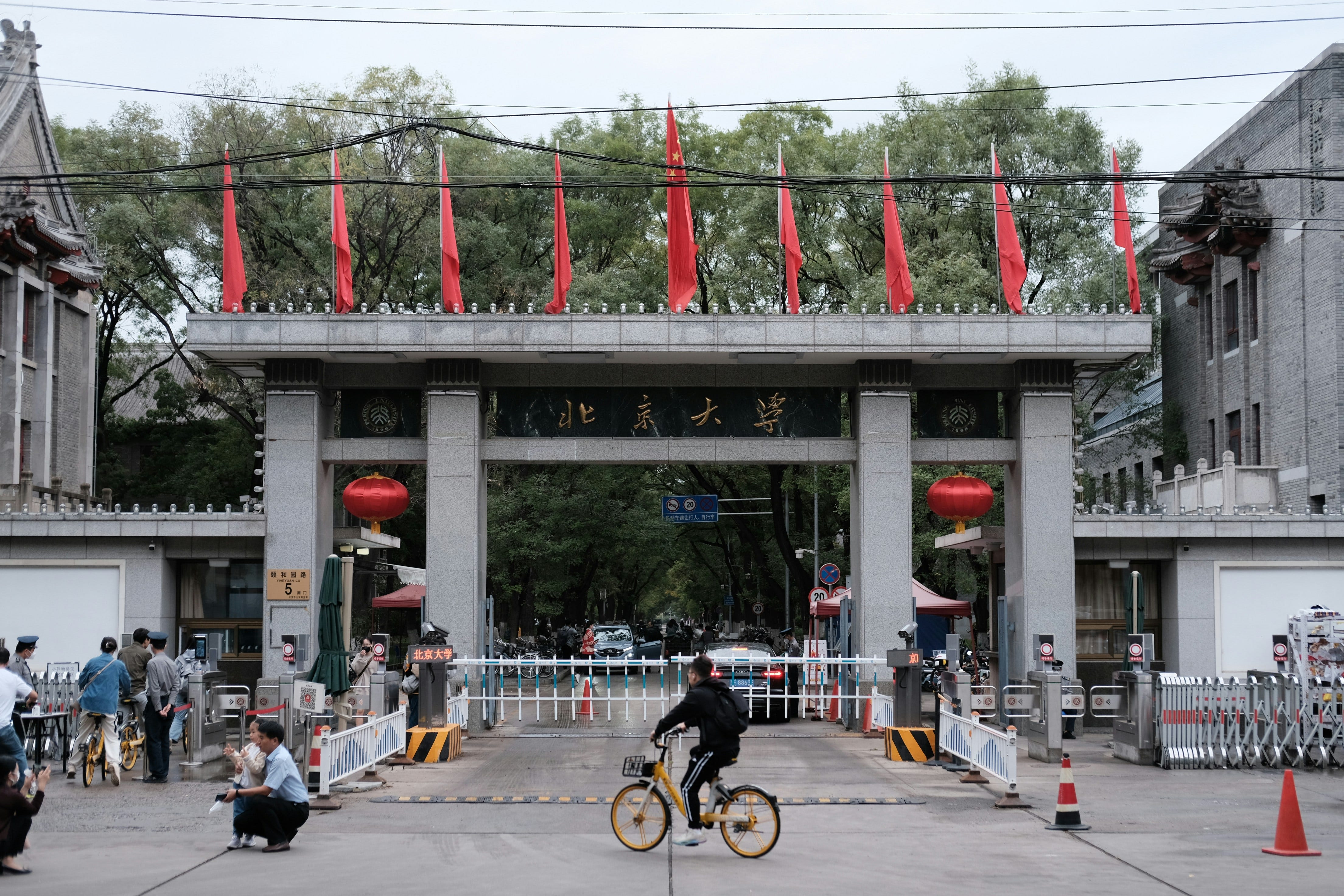
I lived in China through the 1990s and the early 2000s. I learned Mandarin, attended post-grad at Peking and Nanjing Universities, later worked in Beijing and Hong Kong, and was in China when its technology sector was born.
During that period, near Peking University, I worked with the founders of Legend, the company that would eventually become Lenovo, acquire IBM’s PC division, and emerge as one of China’s foundational tech stories of the 21st century. My role at the time was to help the company to seek foreign capital, which required translating not just language but commercial prospects, market context, and an investment thesis to skeptical American and European investors. It wasn’t easy.
That experience and many others shaped the way I think about China today. The fundamental dynamic I observed back then is the same today, but with vastly greater scale and complexity: China builds commercial infrastructure around technology faster than any other ecosystem in the world, and the relationship between state and private enterprise is inextricable but often opaque, a dynamic that has intensified as China's economy has matured.
Foreign founders who arrive without understanding at least those two realities often learn hard lessons. Yet China, despite the rhetoric, has always been strategically open to foreign technology it cannot yet build itself.
How is the China of today different?
For starters, domestic venture and state capital are larger by orders of magnitude. China’s technology is now genuinely world-class; and the deep tech regulatory environment is more sophisticated and consequential than anything back in Legend’s day. Yet, the core questions of how technology ventures should navigate the market, whether in deep tech, med tech, bio, climate and other domains, have not changed much, and are no easier to answer.
The tendency among many is simply to ignore China. Too complex, not worth the effort, move on. Which is precisely why most founders simply opt out. That is the wrong response.
Why a China strategy is not optional
Most PhD founders and others in my network hold one of two extreme positions on China: enthusiastic (with maybe a touch of naivety) or total avoidance. Both are wrong.
The enthusiastic founder looks at China’s scale: the world’s second-largest venture market, a manufacturing infrastructure that can compress commercialization timelines from three years to eighteen months, and patient state or other forms of capital with a twenty-year investment horizon. The founder assumes the path from technology to Chinese market adaptation is straightforward. It never is.
Then there are founders who want to avoid China like the plague: they read US media headlines about US decoupling, export controls, IP risk, regulatory crackdowns, executive detentions—all with shades of truth, by the way—and conclude that China is just not worth considering. But that conclusion is also wrong, and can be increasingly costly as Chinese competitors build in sectors where Western deep tech founders have genuine technological leads.
The more realistic approach is a more nuanced, deliberate, well-researched China strategy that can answer this question: “what is my technology’s (or related innovation’s) relationship to China, and what does the country mean for my commercialization strategy?”
To build this strategy, I’ll consider several angles.
The affirmative case: why China cannot be ignored
There are five reasons a PhD founder needs a China strategy, even if, ultimately, it is not going to be executed.
China’s scale is incomparable. By Q4 2025, China’s tech deal volume exceeded Europe’s by roughly 80% and almost US levels. Despite raising a similar amount of capital to Europe, Chinese startups generated roughly 4x more PE/VC exits than their European counterparts. For a PhD founder building a technology with global applications, ignoring the world’s second-largest venture market can be a costly mistake, and one which investors will not ignore.
China is where your competition is building.
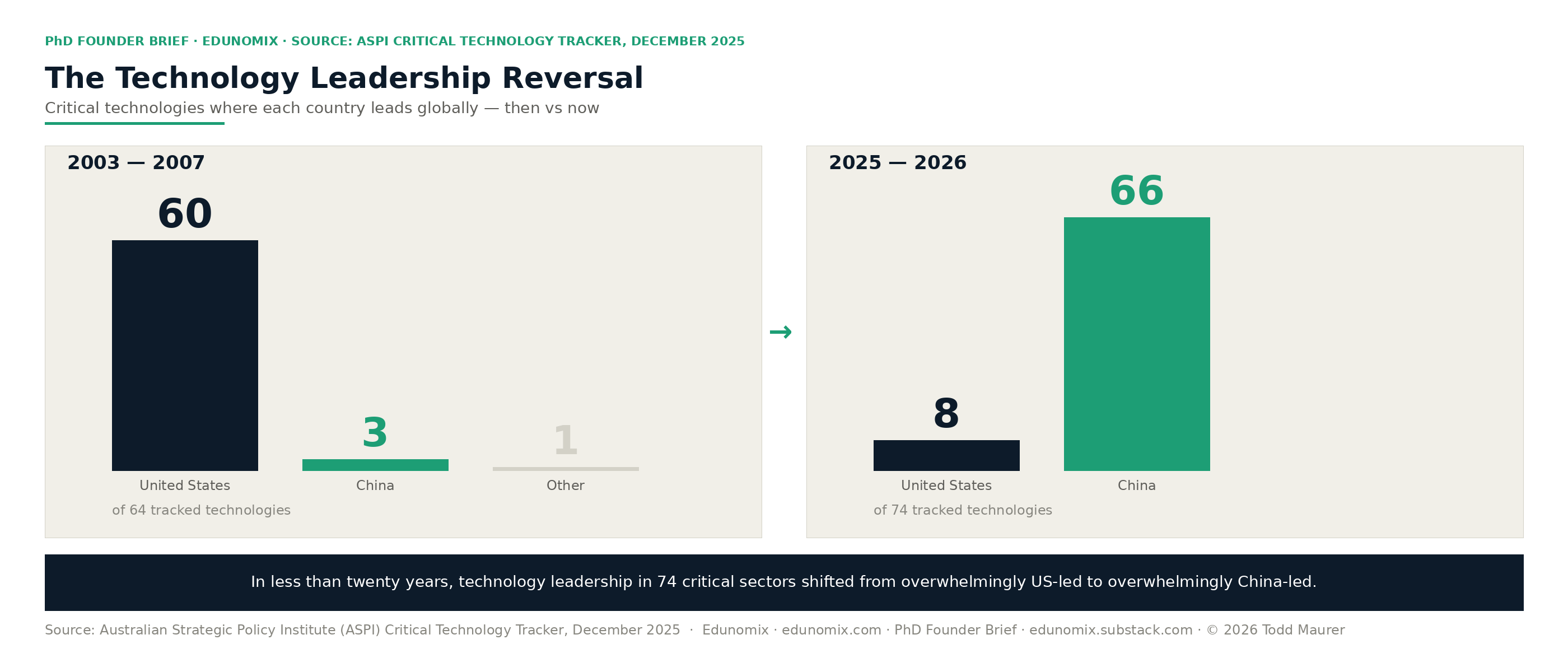
China now leads in 66 of the 74 critical technologies tracked by the Australian Strategic Policy Institute’s Critical Technology Tracker, versus the US leadership in the remaining eight. For comparison, from 2003–2007 the US led 60 of 64 tracked technologies. Why should founders care? Because if you’re innovating in advanced materials, energy, robotics, or biotech, among other fields, it’s likely the most formidable competitors will be from China. Understanding that ecosystem is critical intelligence, whether you develop the market or not.
“Scholar-entrepreneurs” are highly valued. Founders with strong academic backgrounds and research and development expertise, often termed “scholar-type” or “expert-type” entrepreneurs, are increasingly sought after by both investors, the Chinese government and the market. In an opportunistic sense, a PhD founder with credible research IP is exactly what China’s deep tech market is looking for, in sectors where foreign involvement is permitted.
China’s manufacturing and deployment infrastructure is unmatched. China's manufacturing advantage is well-documented, yet its implications for deep tech commercialization are still under appreciated. In deep tech ventures in, say, advanced manufacturing, energy storage, robotics hardware, and materials science, China’s manufacturing infrastructure, supply chain depth, and speed of industrial deployment is unmatched. A technology that takes three years to reach manufacturing scale in Europe or the US can reach it in eighteen months or less in China. Think of this speed of commercialization as itself a form of IP protection; China’s industrial infrastructure makes that speed achievable to many ventures at home and abroad.
Capital is patient, abundant, and focused on core sectors. China’s national venture capital guidance fund, with CNY1 trillion (approximately $138 billion) typically adopts a 20-year lifespan. As with many sovereign funds, these extended investment and exit periods are designed to provide long-term funding support. Its principle is “investing early, investing small, investing long-term, and investing in hard technology.” For a deep tech venture with a ten-year commercialization timeline, this patient state capital can keep research ventures alive while angels and VC funds balk.
All of this suggests that the affirmative case is real. Now the downside risks.
Reality check: five structural obstacles
These five structural realities are what the enthusiastic founder misses:
Reality 1: Both doors are closing simultaneously. The US banned its own investors from backing Chinese AI and chip companies starting January 2025. China is now doing the same in reverse: not an outright ban, but a government permission requirement that achieves roughly the same effect. For a PhD founder whose technology touches AI, semiconductors, advanced materials, quantum, or biotech, the regulatory environment on both sides of the Pacific is tightening, not loosening. You need to understand how your technology is classified in this bilateral context.
Reality 2: The IP environment is better than it was, but the TTO question is unresolved. China’s IP enforcement has improved significantly in the last decade, including patent filings, court infrastructure, and enforcement mechanisms. part of the reason is that Chinese companies need their own IP protected as well. However, for a university spinout whose base patent is licensed from a US or European TTO, the IP question in China is structural rather than legal: what does your TTO licensing agreement say about sub-licensing in China? Most TTO agreements have provisions that PhD founders have never read carefully enough to answer that question. The Brief’s four-layer IP moat framework applies here, but the China-specific dimensions require dedicated legal advice before any commercial engagement begins.
Reality 3: Entity structure is more complex than it has ever been (and that’s saying a lot). On June 1, 2026, China’s State Council published the Regulations on Outbound Investment, effective July 1, 2026. The ODI (Outbound Direct Investment) Regulations expand China’s existing outbound direct investment regime to include new types of cross-border technological collaboration. Importantly, ODI review now integrates technology export licensing, export controls, and data transfer compliance.
What is often called “offshore washing,” a popular structure using Cayman/BVI domicile, IP migrations, or personnel relocations that are designed to avoid “China-origin” issues from regulatory reach, are no longer a regulatory panacea. Suffice to say, your potential entity structure in China will now require even more careful legal attention, which adds time and cost at exactly the stage when most founders need to move fast.
Reality 4: Taking state capital comes with strings attached. Government-linked investors in China went from fewer than 10 AI deals per year before 2018 to more than 140 deals in 2025, a roughly 15x increase in participation. For a foreign PhD founder seeking Chinese co-investment, understanding whether your potential investor is state-affiliated is now a compliance requirement under the US outbound investment rules. The CNY1 trillion guidance fund’s patient capital mentioned previously can be genuinely attractive for deep tech ventures. But patient capital from a state-backed fund carries specific governance and reporting obligations that look nothing like a VC term sheet.
Reality 5: Market access is sector-specific and narrowly targeted. If we are talking about AI, space, quantum computing, dual-use technologies and semiconductors, for example, opportunities for foreign startups will be limited as the Chinese government is determined to nurture indigenous ventures. The sectors where China actively welcomes foreign deep tech participation, for now, are advanced manufacturing and industrial process technology, green energy and storage, agricultural biotechnology, precision medicine with non-sensitive data, and materials science, particularly composites, rare earth applications, and next-generation battery materials. Other areas, such as robotics, clean energy data infrastructure, and biotech with data components, have a regulatory environment that is less clear.
For all of the foregoing risk factors, knowing which category your technology falls into is the critical question: not “should I go to China?” but “is my technology in a sector where China wants foreign participation?”
The PROVE sequence applied to China
The Evidence-Based Venture Framework, and its PROVE sequence, introduced in last week's Brief, applies directly to China, though each layer looks different when the market is China, and sometimes significantly so.
P (Positioning): Translation is doubly difficult in China because it requires not just science into commercial language but Western commercial language into Chinese market context. The venture client model that works with Siemens or Aramco might not with Chinese industrial partners, particularly where state-owned enterprise (SOE) relationships and government procurement pathways operate with their own logic (or illogic, as it happens). Ultimately, positioning for China requires a China-specific commercial narrative, not a direct translation of your Western pitch.
R (Resources): There is no SBIR or EIC equivalent accessible to foreign founders. The only non-dilutive options available in China are primarily government grants such as provincial innovation funds, and national science foundation equivalents, and they are mostly inaccessible without a Chinese entity and Chinese co-founders. Often, corporate partnerships and state-guided VC are potential entry points, not grants, so the sequencing is different from what this Brief has outlined previously (see Non-Dilutive Playbook).
O (Operation Proof): The pilot-first logic can still work, but the partner matters more in China than anywhere else. If you work with Chinese state-owned enterprise it will fall under a different commercial and regulatory environment than with a private Chinese industrial company (and even with private enterprise there are still complexities, because nothing is truly private). Expect that SOE alignment can be highly bureaucratic and slow, with complex IP terms and governance considerations. You need to choose your pilot partner in China as carefully as you would choose a co-founder, since the relationship is that consequential.
V (Value Protection) This is the most complex layer to consider. There are at least three questions every PhD founder must answer before any Chinese commercial engagement: What does your TTO licensing agreement say about sub-licensing rights in China? Have you filed defensively in China under the PCT? And have you mapped your trade secrets and know-how carefully enough to know what you are sharing in a pilot that you cannot un-share? In China, layers three and four of the IP moat, namely trade secrets and proprietary data, are more critical than the patent layer, because enforcement of trade secret misappropriation in Chinese courts has improved significantly more than patent enforcement
E (Entity Structure) What used to be fairly straightforward, this layer is now increasingly vexing for founders in China. Forming an entity structure such as a WFOE, VIE, joint venture, in light in light of the new ODI (Outbound Direct Investment) Regulations effective July 2026, will require specialist legal advice, not just a start-up attorney. The key question to ask is not “what entity structure works best?” but “what entity structure is compliant with both Chinese regulatory requirements and US outbound investment rules (including new NSF guidelines) simultaneously?”
ONE ACTION
Before your next conversation about China, whether it’s with a potential partner, investor, or academic collaborator, answer three questions:
Question 1: What does your TTO licensing agreement say about sub-licensing rights in China? If you don’t know, find out before any commercial discussion begins. This single clause can determine whether a Chinese commercial relationship is even possible.
Question 2: Does your technology touch any of the sectors covered by the US outbound investment rules, such as AI, semiconductors, quantum, advanced biotechnology? If so, you need specialist legal advice before accepting Chinese investment of any kind, attending a Chinese government-sponsored conference, or signing a Chinese research collaboration agreement.
Question 3: Do you have a Chinese academic or research relationship that could serve as the foundation for a commercial conversation? If not, start there. This relationship infrastructure comes first and can bring significant benefit throughout the process.
In my experience, China rewards founders who enter with their eyes wide open and who are prepared with a clear strategy, a clean and legally vetted IP structure, strong and sustainable relationships, and specialist legal advice. Founders who think China is going to fast-track their commercialization without a water-tight plan are in for a rude awakening.
China is not the easiest market, and never has been. But for PhD founders who do the prep work, who understand the regulatory landscape, have mapped their IP carefully, and have built the relationship infrastructure, it remains one of the most consequential markets in the world. Founders who succeed in China understand the rules of the game before they start playing.
I learned that lesson watching Legend’s founders navigate foreign investors in the 1990s. The dynamic was simpler then. The principle was identical.
The PhD Founder Brief is published weekly by Todd Maurer — founder of Edunomix, owner of VersatilePhD. Global signals for founders building evidence-based ventures.
Need advice? Work with Edunomix → | TTO or university innovation office? Bring the PROVE sequence to your cohort →
Sources
DeepTech Asia: “2025: Renaissance of China’s Deep Tech VC” (January 7, 2026)
DealStreetAsia: “Investors, academics home in on China’s deep tech & AI influx” (May 28, 2026)
China State Council: CNY1 Trillion VC Guidance Fund (December 26, 2025)
The Tech Portal: “Beijing shifts state venture capital focus towards semicon and deep tech” (December 26, 2025)
Fortune: “DeepSeek and China’s AI boom are increasingly powered by state money” (May 20, 2026)
Fortune: “China isn’t trying to beat the U.S. at AI” (June 16, 2026) · Swissnex China: “Building for the accelerator state” (June 26, 2025)
Morrison Foerster: “China’s ODI Rules Just Changed” (June 4, 2026)
Morgan Lewis: “Regulation on Outbound Investment” (June 2, 2026)
China Briefing: “Is WFOE Still the Right Corporate Structure for China in 2026?” (April 7, 2026)
ICLG: “Foreign Direct Investment Regimes — China” (November 2025)
ASPI: Critical Technology Tracker (December 2025)
Stanford HAI: AI Index Report 2026
ITIF: “US Technology Companies Should Keep Operating in China” (May 4, 2026)
Tracxn: Deep Tech in China 2026
UBP: Investment Outlook 2026 — China Technology